
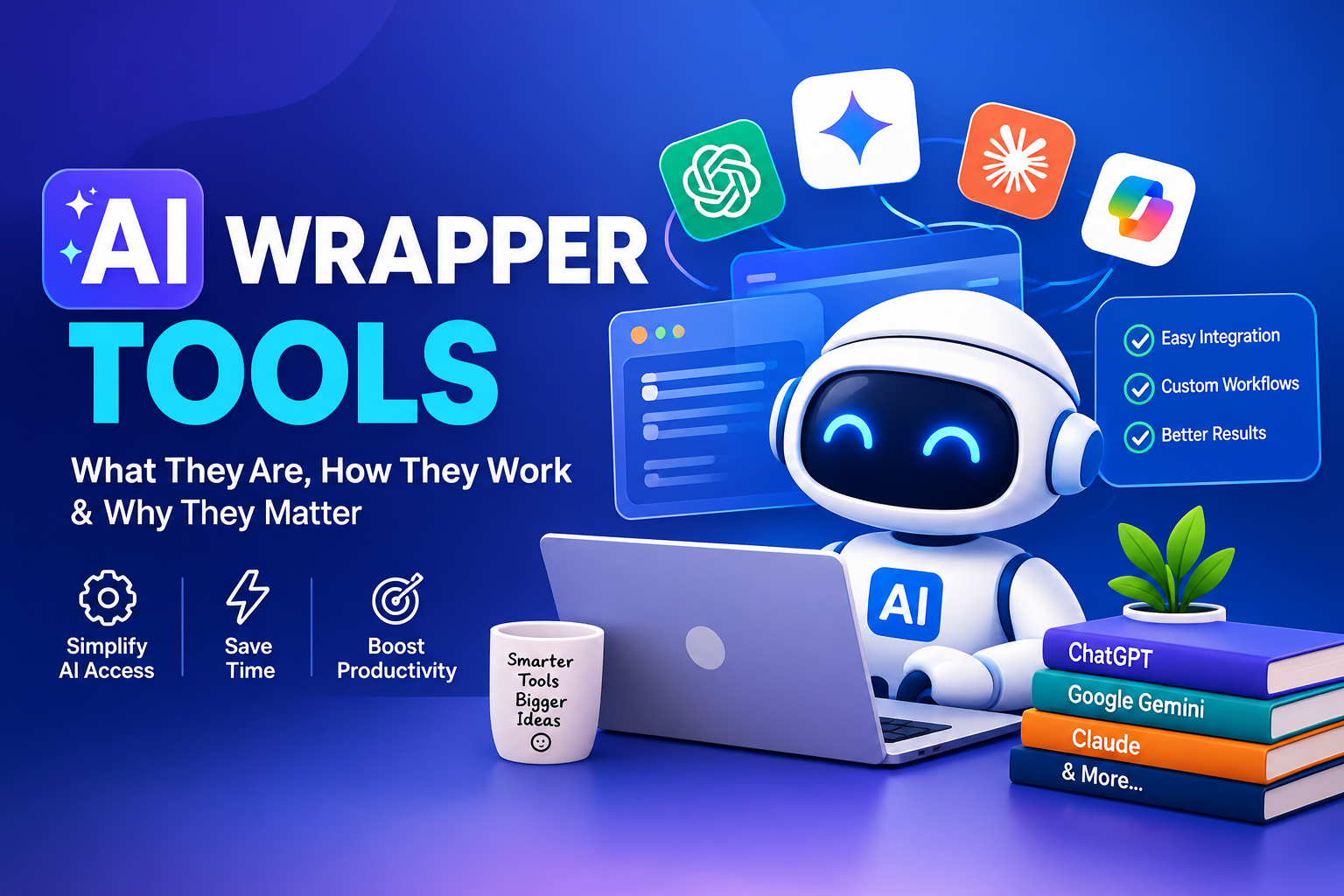
Focus Keyword: AI wrapper tools for beginners 2026
Secondary Keywords:
- What is an AI wrapper?
- AI wrapper tools
- AI tools for beginners
- AI-powered applications
- How AI wrappers work
- Benefits of AI wrappers
Suggested URL Slug: ai-wrapper-tools-for-beginners-2026
Category: Artificial Intelligence
Search Intent: Informational
SEO Meta Description: Discover AI wrapper tools for beginners in 2026. Learn what AI wrappers are, how they work, their benefits, limitations, and practical uses.

AI Wrapper Tools for Beginners in 2026: A Complete Guide
AI Wrapper Tools for Beginners in 2026: A Complete Guide
Artificial intelligence is changing how people interact with technology. From writing assistants to productivity applications, AI-powered software is making complex tasks easier for everyday users.
One technology concept gaining attention is AI wrapper tools. These applications use existing artificial intelligence models and add specialized features, interfaces, and workflows to make them more useful for specific tasks.
If you are new to artificial intelligence, understanding AI wrappers can help you explore how modern AI applications work and how they fit into everyday digital activities.
In this beginner-friendly guide, we will explain what AI wrappers are, how they work, their benefits, limitations, and practical examples.
What Are AI Wrapper Tools for Beginners in 2026?Benefits of AI Wrapper Tools for Beginners
AI wrapper tools are software applications built around existing artificial intelligence models.
Instead of developing an entirely new AI model, developers connect to an existing model through an application programming interface (API) and add features that make it easier to use.
These additional features may include:
- A user-friendly interface
- Specialized prompts and instructions
- Document processing
- Automated workflows
- Data organization
- Integration with other applications
For example, a general AI model can generate text. A specialized writing application may add templates, editing features, and structured workflows to help users create specific types of content.
The underlying AI model provides the intelligence, while the wrapper organizes that capability into a practical application.
How Do AI Wrapper Tools Work?
An AI wrapper generally works as an intermediary between a user and an existing AI model.
Here is a simplified explanation of the process:
Step 1: User Input
The user enters a question, instruction, document, or request into the application.
Step 2: Input Processing
The wrapper organizes the user’s input and may add instructions, templates, or relevant context.
Step 3: AI Model Connection
The application sends the processed request to an AI model through an API.
Step 4: Response Generation
The underlying model processes the request and generates a response.
Step 5: Output Formatting
The wrapper presents the result in a useful format, such as a summary, report, draft, or structured response.
This process allows developers to create specialized AI experiences without training a large model from scratch.
Common Types of AI Wrapper Tools
AI wrappers can be designed for different purposes. Here are some common categories beginners may encounter.
1. AI Writing Assistants
Writing-focused applications help users draft, summarize, edit, and organize text.
Common uses include:
- Creating first drafts
- Improving sentence clarity
- Generating content outlines
- Summarizing documents
- Checking grammar and readability
Users should review AI-generated content for accuracy, originality, and appropriate tone.
2. AI Research Assistants
Research-oriented wrappers organize information and help users explore complex topics.
Depending on their features, they may provide document summaries, source organization, or question-answering capabilities.
Always verify important claims against reliable sources.
3. AI Design Applications
Some applications combine AI image-generation capabilities with editing interfaces and design templates.
They may help users create visual concepts, social media graphics, presentations, or design drafts.
4. AI Productivity Applications
Productivity-focused wrappers organize repetitive tasks into simpler workflows.
Examples include meeting summaries, task organization, document classification, and structured note-taking.
5. AI Coding Assistants
Coding applications integrate AI into development environments to help explain code, suggest changes, and assist with debugging.
Generated code should be reviewed and tested before being used in a real project.
AI Wrapper Tools vs. General AI Assistants
Although these applications may use similar underlying models, their user experiences can differ.
| Feature | General AI Assistant | Specialized AI Wrapper |
|---|---|---|
| Main purpose | Multiple general tasks | Specific workflows |
| Interface | General chat interface | Task-focused interface |
| Templates | May offer general templates | Often specialized templates |
| Integrations | Depends on the platform | Designed around particular workflows |
| User experience | Broad and flexible | Focused on a particular use case |
Neither category is automatically suitable for every task. The right choice depends on what you need the software to accomplish.
Benefits of AI Wrapper Tools for Beginners
Easier User Experience
A specialized interface can make AI capabilities easier to understand, particularly for people who are unfamiliar with technical terminology.
Task-Specific Features
Instead of starting with a blank chat window, users may have access to predefined templates and structured workflows.
Less Technical Complexity
Many AI wrappers hide the complexity of API connections and model configuration from everyday users.
Workflow Organization
Some applications combine multiple steps into one process, helping users organize repetitive digital tasks.
Specialized Applications
Wrappers can be designed for specific industries or activities, including education, content production, software development, and business administration.
Limitations and Risks of AI Wrappers
AI wrappers are useful, but beginners should understand their limitations.
1. Dependence on Underlying AI Models
Many wrappers rely on third-party AI providers. Changes to model availability, pricing, or API functionality may affect the application.
2. Output Accuracy
An AI wrapper cannot automatically guarantee that generated information is correct.
Review important facts, calculations, and technical instructions before relying on them.
3. Privacy Considerations
Some applications process user inputs through external services.
Before uploading personal or confidential information, review the application’s privacy policy and data-handling practices.
4. Subscription Costs
Some AI applications offer free access with usage limits, while others require subscriptions or usage-based payments.
Check current pricing and limitations before subscribing.
5. Limited Additional Value
A simple wrapper may provide little beyond what a general AI assistant already offers.
Look for meaningful features such as specialized workflows, useful integrations, document handling, or clear productivity benefits.
How Beginners Can Choose an AI Wrapper Tool
If you are exploring AI wrappers for the first time, consider these practical factors.
Identify your task: Decide whether you need help with writing, research, organization, design, or another activity.
Check usability: Look for a clear interface and straightforward instructions.
Review available features: Confirm that the application solves a specific problem rather than simply adding unnecessary complexity.
Understand pricing: Check free-tier limits, subscription terms, and usage restrictions.
Evaluate privacy: Understand how the application handles your information.
Verify outputs: Treat AI-generated content as a draft that may require human review.
Practical Examples of AI Wrappers in Everyday Technology
AI wrappers can be used in several everyday scenarios.
| Use Case | Example Application |
|---|---|
| Writing | Organizing article outlines |
| Research | Summarizing uploaded documents |
| Education | Explaining difficult concepts |
| Productivity | Creating structured task lists |
| Design | Generating visual concepts |
| Software development | Explaining code snippets |
These examples describe application types rather than guaranteed features of any particular product.
Are AI Wrapper Tools Useful in 2026?
AI wrappers remain a relevant part of the AI application ecosystem because they connect general-purpose models with specific user needs.
Their usefulness depends on the additional value they provide.
An application that combines relevant context, reliable workflows, thoughtful design, and useful integrations can offer a different experience from a basic AI chat interface.
However, beginners do not need dozens of AI applications. Starting with one general assistant and adding specialized tools only when needed can make learning easier.
Frequently Asked Questions
What is an AI wrapper in simple words?
An AI wrapper is an application built around an existing AI model. It adds an interface, features, or workflows that make the model easier to use for a particular task.
Do AI wrappers use their own AI models?
Many AI wrappers use existing models through APIs instead of training their own foundation models. Some applications may combine multiple models or additional technologies.
Are AI wrapper tools suitable for beginners?
Yes. Many are designed with user-friendly interfaces and task-specific features. Beginners should still review privacy policies, pricing, and output accuracy.
Are AI wrappers free?
Some applications provide free access or limited trials, while others charge subscription or usage-based fees. Pricing varies by provider and may change.
What is the difference between an AI wrapper and an AI model?
An AI model is the underlying system that processes information and generates outputs. An AI wrapper is an application layer that connects users to that model and may add specialized functionality.
Can AI wrappers make mistakes?
Yes. Because many wrappers rely on generative AI models, their outputs may contain inaccurate or incomplete information. Human review remains important.
Final Thoughts
AI wrapper tools make artificial intelligence more accessible by connecting powerful existing models with practical interfaces and specialized workflows.
For beginners, understanding how these applications work is a useful step toward becoming more confident with modern technology.
Start with a clear task, explore applications carefully, and focus on tools that provide genuine value rather than simply adding more AI features to your workflow.
4. WordPress mein image placement
Article mein ye 3 images use kar sakti hain:

Featured Image
Article title ke liye AI technology dashboard.
Alt text: AI wrapper tools for beginners in 2026

Image 2: How AI Wrappers Work
Isay “How Do AI Wrapper Tools Work?” heading ke neeche add karein.
Alt text: How AI wrapper applications work

Image 3: Practical AI Applications
Isay “Practical Examples” section ke paas add karein.
Alt text: Practical AI wrapper tools for everyday tasks
AI Wrapper Tools for Beginners in 2026: A Complete Guide
For more helpful technology tips, explore our latest [AI and technology guides] and discover useful tools, tutorials, and updates on TechNexa.About Us
